My first ever trip to California was for the 15th international American Cetacean Society Conference, which also happened to be the society’s 50th anniversary. The conference is held every other year, and this past November (from the 11-13th) it was held in Monterey. I soon discovered that California is a hot spot for marine life of all kinds. The weekend kicked off with an eight hour long whale watch trip into Monterey Bay, with the company Monterey Bay Whale Watch, which did an excellent job educating the guests aboard the ‘Blackfin’ on all of the local flora and fauna. Before we even pulled out of the harbor, we could spot humpback whales in the distance and dozens of sea lions resting along the shorelines.
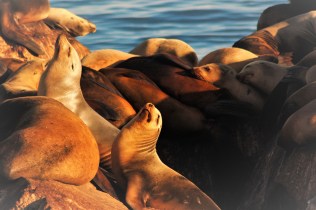
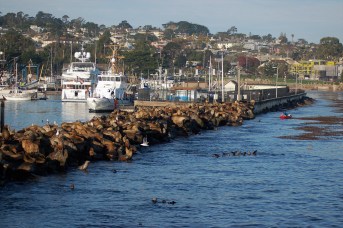
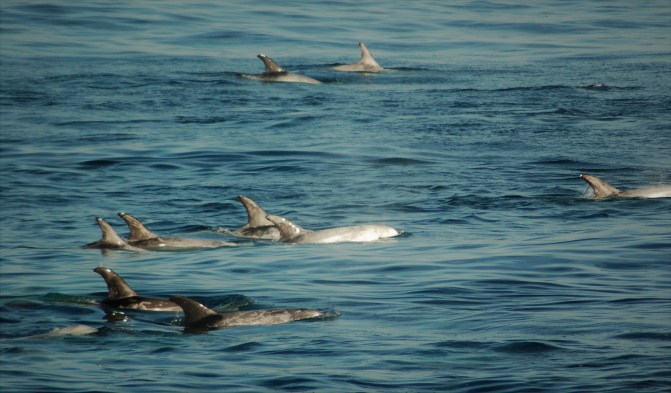
Only five minutes into the trip we spotted two humpback whales, and shortly after we came upon a pod of Risso’s dolphins. It was the first time that I had ever seen this species, and it was definitely one of the highlights of the day. There was over 100 individuals in the pod and they completely surrounded the boat for several minutes until we moved onward further into the bay.
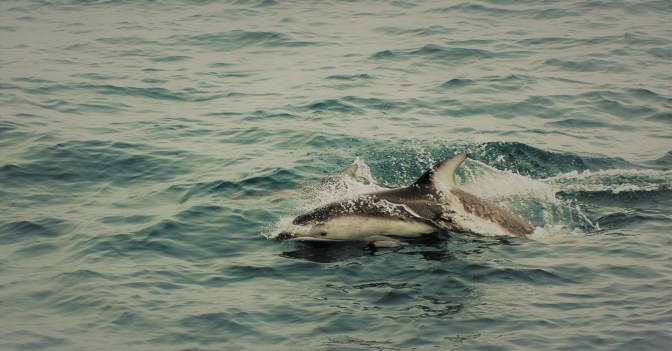
By early afternoon the sun had gone behind the clouds and the wind picked up. It was cold despite my efforts to stay out of the wind. The fog rolled in over the water and soon we couldn’t see very far in any direction around the ‘Blackfin’. There was a report of a lone killer whale near us in the bay, but because of the fog, it defied our efforts to spot him. We were visited however by a few Pacific White Sided dolphins which played in the wake of the boat and jumped alongside us for a few minutes. They were quick and hard to catch a photo of, but after several tries, I finally managed to capture a decent picture of one that was in focus. Some of the more experienced whale and dolphin watchers had an easier time, but as a student from the Midwest who had only previously captured photos of orcas, these smaller and quicker dolphins gave me a hard time.
Finally, after more time searching, the fog lifted a bit and we were able to end our day with a few humpback whales who gave us quite the show. I was able to observe lunge feeding behavior, tail lobbing, pec slapping, and a few breaches. It was also my first time ever seeing a humpback whale, and I was in awe of their beauty and size. It was amazing to see them feeding and how easily they coordinated their large bodies to perform a kind of water ballet, each movement serving an important purpose. The following of seabirds and sea lions that they had gave us clues as to when they would surface to feed, with the birds and sea lions picking off any left over fish scraps and taking advantage of the whales hard work. We spent a few hours with them before heading home for the day, but even as tired as I was after eight hours on the water, it was a day I will never forget.


Saturday and Sunday were official conference days full of talks from well known biologists discussing current scientific studies and observations of various marine mammals. The discussions also included talks on the development and uses of technology in marine mammal research, the current status of humpback whales (including talks on whale entanglement and response), and the future directions of the American Cetacean Society. It was fun, educational, and a perfect gathering of friends and mentors. I look forward to attending this (and similar) conferences in the future!
Written by Candice Smith
Founder of Wild for Nature

 WILD4NATURE.ORG: EXPLORE, CONSERVE, EDUCATE