
Personal experiences are often the best motivation for writing about an issue, especially when that issue is one that is close to your heart. A friend of mine on Facebook tagged me in a post not too long ago that included a photo and a short caption. The caption was something along the lines of “So crazy! There was an actual wild wolf sitting in my yard!! What do I do?” along with a blurry photo of a canine of some sort sitting at the edge of the yard by the trees. Taken into account that this photo was taken in Missouri (in a subdivision), the chances of it being a wild wolf were VERY slim. What caught my attention though wasn’t the caption or the photo, but the reactions that the post was getting. One woman was demanding that she shoot it immediately saying that wolves were dangerous, and it was going to attack and carry off her children. Others were debating how to handle the situation and what kind of canine it was while clearly in an uproar about this elusive beast in the subdivision. From closer examination of the photo, it looked too large to be a coyote, but also had some obvious features of a dog including what looked like an all white face. It seemed to me that this animal was neither wolf nor coyote, but a wolfdog which is a cross between a dog such as a husky or Alaskan malamute and a wolf. I tried to calmly explain this in the post, as well as why it wouldn’t be a good idea to shoot an animal when you haven’t yet identified what it is, as it could possibly be somebody’s escaped pet. So among the false accusations of wolves and the inability of people to distinguish between wolf, coyote, and wolfdog, I thought it would be a good idea to explain all three as well as debunk a few wolf myths. It is still unknown to me exactly what the canine in the blurry photo was, so I can’t be for certain, but so that people are no longer confused if they do see one of the three canines mentioned above let me give a short explanation. Hopefully this will clear things up as well as rid folks of a few misconceptions.
Coyote
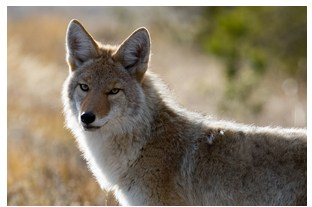
Coyotes (Canis latrans) are native to North America and are much smaller than their cousin the gray wolf. The males and females are similar in size with the males ranging from 18-44 pounds and the females topping out near 40 pounds. Coyotes do very well in suburban areas and can adapt to almost any environment which is why they have such a large and varied geographical range. Normally, their fur color is light gray or red although sometimes it can be interspersed with black and white hairs. They have large ears and live in very loose knit groups of unrelated individuals. Often they are seen either singularly or in pairs, although they commonly come together to form larger packs. Coyotes feed on smaller mammals, birds, invertebrates, and fish. They are opportunists however (which is why they do so well in subdivisions), and will regularly feed on anything they can get a hold of if they think they can manage it as a prey source. They are generally not a threat to humans and are skittish. They will feed on people’s smaller pets though so caution does need to be taken when leaving your pets out at night.
Gray Wolf
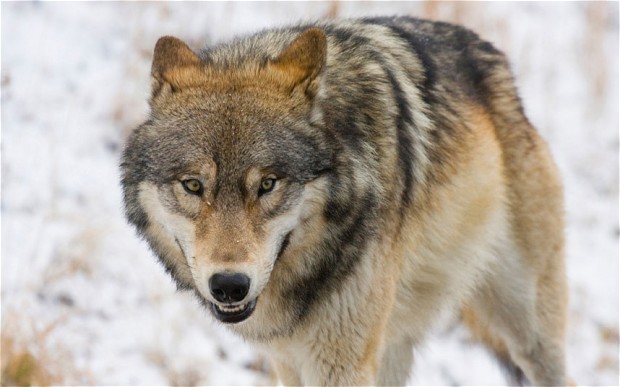
The gray wolf (Canis lupus) is the largest member of the canine family and is native to North America though their current range is only a fraction of what it was historically. Today there are established wolf packs in Alaska, Montana, Wyoming, Idaho, Minnesota, Wisconsin, Michigan, Oregon, and Washington. There are an estimated total of 5,547 wolves in the lower 48 and up to 11,000 wolves in Alaska alone. The gray wolfs’ appearance is much different from the coyotes. They range in size from 95 to 99 pounds for males and around 80 pounds for females. They have less pointed features than the coyote especially on the ears and muzzle. Their ears tend to be more rounded and well furred, and in the winter they have long thick coats ranging in color from gray, to reddish, to black. Gray wolves also have large paws with webbed toes for making traveling over and through ice and deep snow easier. They are strongly bonded to their pack members which will often consist of a mated pair and their pups. Wolves are also one of the few animals that mate for life, and only the alpha male and female are allowed to produce offspring. Pack sizes range from 2-30 although the average size is ten members. Wolves specialize in preying on large ungulates such as deer, elk, and bison. A wolf pack taking down large prey is one of nature’s greatest spectacles. However, like many other predators, will also eat rabbits and other small mammals to get them by if times are scarce. Contrary to popular belief, wolves are not vicious killing machines nor do they pose an immediate threat to humans. Wolves are very skittish and try to avoid human conflict as much as possible. Wolf attacks on people are RARE and since 1900 only two people have been fatally attacked (one of which occurred in Canada and the other in Alaska). So no, the big bad wolf will not steal your children from your yard and carry them off to devour them. However, wolves are wild animals and using common sense with very small children and pets is always advised if you live in an area where wildlife and predators are abundant. Education on how to co-exist with all large predators is key. Wolves also don’t howl at the moon, but I’ll save that for a different blog 😉
Wolfdogs
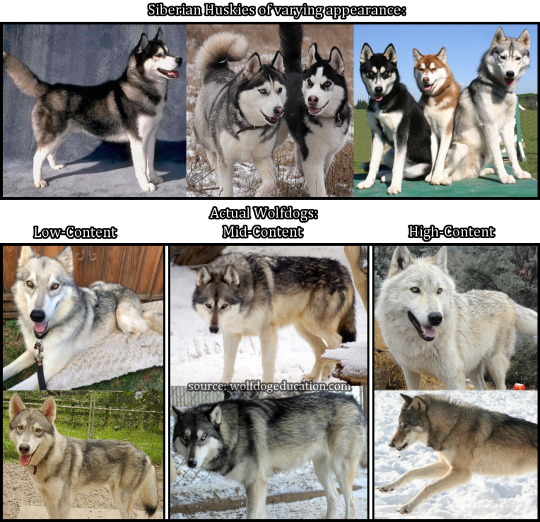
Wolfdogs are extremely varied in looks and their behavior depends on the amount of wolf content in the animal. I could write an entire blog on nothing but wolfdogs (which perhaps I will do later) but I will try to stick to the general idea for this one. A wolfdog is a cross between a dog (most commonly a husky, Alaskan malamute, or German shepherd) and either a pure wolf or another wolfdog of various content. Depending on the wolf content in the animal, it may look more dog-like or wolf-like. A low content wolf dog will look much more like a dog with only one or two wolfy features while a high content is almost indistinguishable from a pure wolf. The photo below shows this well:
Wolfdogs are illegal in some states while in others a person has to own a permit to acquire one. They should not be treated like house pets and require ample space and secure fencing. Many wolfdogs are turned into shelters each year because people think it would be an amazing experience to own a wolf. What they come to realize is that they don’t fit into their subdivision or apartment lifestyle. They are very skittish around strangers and strange places do to their wild instincts. However, they become very attached to their family or “pack” members, so it’s extremely hard on these animals when they are turned over to new people and end up in bad situations. It’s also difficult to re-home them because they require experienced owners. With proper socialization and care, and in the right home however, they can make amazing companion animals and be used as ambassadors for their wild wolf cousins to help the public understand wolves and debunk myths surrounding them.

 WILD4NATURE.ORG: EXPLORE, CONSERVE, EDUCATE